

We were at dinner with friends recently, talking about our younger selves. What we used to be into. What we used to make. How being creative back then felt less like an activity and more like a way of being alive.
Somewhere in the middle of the conversation, one of us said something that I haven’t been able to set down.
“When we treat being creative like ‘just a hobby,’ life takes over and creativity takes a back seat. That’s unfortunate, because creativity is how you see life differently.”
The table went quiet for a moment. Not because it was profound exactly. Because it was true, and we all knew it.
I’ve been pulling on that thread ever since.
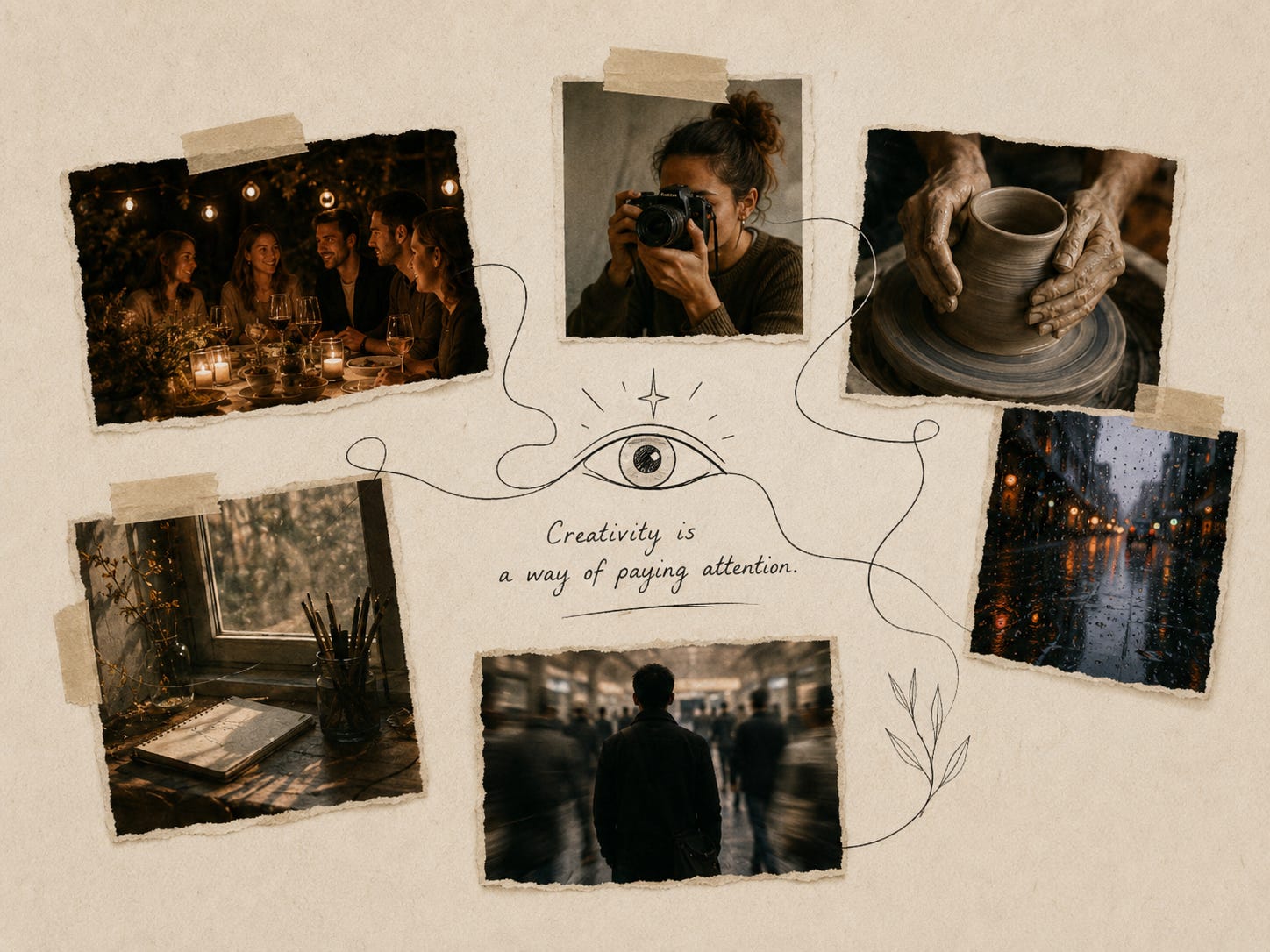
There was a time when creativity was not something I scheduled. It was something I lived inside. I wrote poetry without needing a reason. I picked up a camera because something caught my attention. I worked with clay not to produce anything meaningful, but because the act itself felt like meaning. Creativity was not a skill I was trying to improve. It was a way of relating to the world.
Looking back, what stands out is not what I created. It is how I saw.
When you are in a creative state, your awareness sharpens. You notice texture, contrast, subtle shifts in tone and feeling. A passing moment is not just something that happens. It becomes something to explore, interpret, or translate into another form. You begin to live in layers. There is the moment itself, and then there is your experience of the moment, and then there is the possibility of shaping that experience into something that can be shared.
Creativity, at its core, is a way of paying attention.
Then adulthood arrives, not suddenly, but gradually. Responsibility accumulates. Career paths take shape. Time becomes structured around output, performance, and measurable progress. The question shifts from “What could this become?” to “What needs to get done?”
Without realizing it, creativity moves to the margins.
It does not disappear. It waits.
At first, the trade feels reasonable. There is satisfaction in building a career, in becoming reliable, in learning how to navigate complexity. You gain skills that matter. You become someone others can depend on.
But something else changes, more quietly.
The way you see begins to narrow.
Moments that once invited curiosity now pass without notice. The instinct to pause, reflect, or create is replaced by the instinct to move on. Even when you do have time, it can feel difficult to access that earlier state of openness. It is not that creativity is gone. It is that your relationship to it has changed.
You start to believe, often unconsciously, that creativity is optional. Something extra. Something you will return to when things settle down.
Things rarely settle down.
What gets lost in that shift is not just creative output. It is a way of experiencing life. Creativity is not only about making things. It is about how you interpret what is happening around you and within you. It expands what you notice, and by extension, what you consider possible.
Without it, life can become more literal.
You respond to what is directly in front of you. You solve problems. You manage responsibilities. You move from one task to the next. This is necessary. It is also incomplete.
Because creativity does something that productivity cannot.
It reintroduces possibility.
For years I thought I’d lost that part of myself. Then slowly, without naming it as a comeback, I started to recognize it returning — just not in the forms I expected.
I’m not writing poetry anymore. But I’m writing this.
I started something I call Trevor’s Test Kitchen — partly because I love to cook, partly because developing a recipe turns out to be the same kind of attention I once paid to a photograph. You taste, you adjust, you notice what’s missing, you try again. The medium changed. The orientation didn’t.
I started a podcast because I wanted to have conversations with ordinary people who turn out to have extraordinary stories. That’s a creative practice too — believing there’s something worth listening for in a person most people would walk past.
I build self-awareness presentations because I keep finding new ways to translate what I’ve learned into something usable for someone else. And ETC, this publication, is the most recent form. A place to pay attention out loud.
None of it looks like what I made when I was younger. All of it comes from the same place.
That, I think, is the part the conversation at dinner was reaching toward. Creativity didn’t disappear from our lives because we stopped being creative people. It receded because we stopped recognizing the new shapes it was trying to take.
If you think about the most engaging conversations you have had, they likely share a common quality. They felt alive. There was movement, discovery, a sense that something was unfolding rather than being repeated. That is the presence of creativity.
It does not require artistic talent. It requires attention and willingness.
The challenge, especially in adulthood, is not understanding this. It is making space for it.
There is a subtle resistance that shows up when you consider returning to creative practices. It can sound practical. You might tell yourself that there is not enough time, or that it is not a priority, or that you are out of practice. Beneath that, there is often something else. A discomfort with being a beginner again. A hesitation to engage without a clear outcome.
Creativity asks for a different posture.
It asks you to explore without certainty. To create without immediate utility. To engage with something simply because it draws your attention. That can feel unfamiliar if you have spent years optimizing for efficiency and results.
Reintroducing creativity into your life is not about reclaiming a past identity. It is about expanding your current one.
You do not need to return to the exact forms you once used. The medium is less important than the orientation.
You might start by noticing more. What catches your attention during the day. What you feel drawn to, even briefly. You might write a few lines, not for an audience, but to capture a thought before it disappears. You might take a photo, not because it is remarkable, but because it reflects how you see something in that moment.
These are small acts. They are also signals.
They signal that you are willing to engage with life as something more than a series of tasks. They reopen a channel that may have been quiet for a long time.
Over time, this begins to influence more than just what you create. It changes how you listen. How you interpret situations. How you respond to uncertainty. You become more comfortable with ambiguity, more open to multiple perspectives, more attuned to nuance.
What you may find, over time, is that creativity was never really gone.
It was integrated into how you once moved through the world. It is still available, but it responds to attention. When you give it space, it returns — not exactly as it was, but in a form that fits who you are now.
More grounded, perhaps. More intentional. Still capable of opening up how you see.
And once that shift begins, something else follows.
Life becomes less about managing what is in front of you, and more about engaging with what could be.
That is the quiet power of creativity.
It changes what you notice, what you consider possible, and how you participate in the conversations that shape your life.
Including the one we were having at dinner.