

Every conversation about artificial intelligence eventually arrives at the same place.
Someone raises their hand and asks the question that many people in the room are already thinking:
“What if we’re working ourselves out of our jobs?”
It’s a question I hear regularly when I teach classes on AI and language models. Sometimes it’s asked directly. Other times it appears as skepticism, resistance, or quiet discomfort. Regardless of how it shows up, the concern is real.
And frankly, I understand it.
When people ask this question, they are not usually asking about technology. They are asking about security. Relevance. Identity. They are asking whether the skills they have spent years developing will still matter in a future that seems to be changing faster than anyone can fully comprehend.
I don’t dismiss those concerns because I don’t think they are irrational. History gives us plenty of examples of technology reshaping entire professions. The internet changed work. Email changed work. Smartphones changed work. Artificial intelligence is already changing work, and anyone paying attention can see it happening in real time.
What I have found, however, is that the conversation often gets stuck in the wrong place.
We spend so much time debating whether AI will replace jobs that we rarely stop to ask a different question:
What role do I want to play in a world where AI exists?
That question feels fundamentally different to me. One question positions us as spectators waiting to see what happens. The other positions us as participants deciding how we will respond.
The difference between those two mindsets is agency.
Agency is the belief that your actions matter. It is the belief that you can influence outcomes instead of simply reacting to them. During periods of uncertainty, agency becomes especially important because uncertainty has a way of convincing people that they are powerless.
I know this because I have felt it myself.
When ChatGPT first appeared in late 2022, I wasn’t looking for a career shift. I wasn’t trying to become an AI expert. In fact, I was mostly curious about why so many people suddenly seemed obsessed with a new technology that few could adequately explain.
Eventually curiosity won.
I signed up for an account and began experimenting. Looking back, my earliest interactions were fairly unremarkable. I used it much like a search engine. I asked questions. I explored ideas. I tested a few scenarios. The experience was interesting, but I didn’t yet see how it might become part of my everyday work.
The turning point came when I was preparing for a lunch-and-learn session on wellness.
Like many presentations I had built before, I started with too many ideas competing for attention. Wellness, productivity, stress management, mindset, resilience. Each seemed important, but none felt like the central thread.
This time, however, I had a new tool available. I began using ChatGPT as a thinking partner. Not to create the presentation for me, but to help me wrestle with the ideas.
As the conversations evolved, one theme kept resurfacing: self-awareness.
That thread eventually led me to research on internal and external self-awareness. I read, reflected, and continued using the language model as a sounding board while I developed the presentation.
When I finally delivered that session, something felt different.
The content was more focused.
The ideas connected more naturally.
The message felt clearer.
The AI had not done the thinking for me.
It had helped me think better.
That distinction became one of the most important lessons I’ve learned about these tools.
The popular narrative often assumes that AI makes people smarter. That’s not how I would describe my experience.
My intelligence didn’t suddenly increase.
My expertise didn’t magically expand.
What changed was my ability to work with information.
For years I had admired people who seemed naturally gifted at synthesizing ideas, creating compelling presentations, and turning complexity into clarity. They could look at a messy collection of information and somehow identify the signal hidden within the noise.
I always appreciated that skill. I just never considered it one of my own strengths.
Then something interesting happened.
The barriers between having an idea and exploring an idea began to shrink.
The barriers between curiosity and experimentation began to shrink.
The barriers between learning and creating began to shrink.
I found myself exploring topics more deeply because I had a tool that could help me organize my thinking, challenge my assumptions, and expose me to perspectives I hadn’t considered.
That lunch-and-learn became more presentations. Those presentations became workshops. The workshops became training programs. Along the way, I started building — small applications that solved real problems. One helped people make sense of a crowded music festival schedule. Another helped people learn how to structure prompts more effectively. Another was designed to reduce the overwhelm many people feel when they first encounter the AI ecosystem.
None of those projects existed because I set out to become a software developer.
They existed because curiosity kept leading me to new questions.
What else could I build?
What else could I learn?
What else might be possible?
Most people won’t follow the same path I did. They don’t have to. The invitation isn’t to become an AI educator or to build apps. It’s just to stay curious longer than feels comfortable.
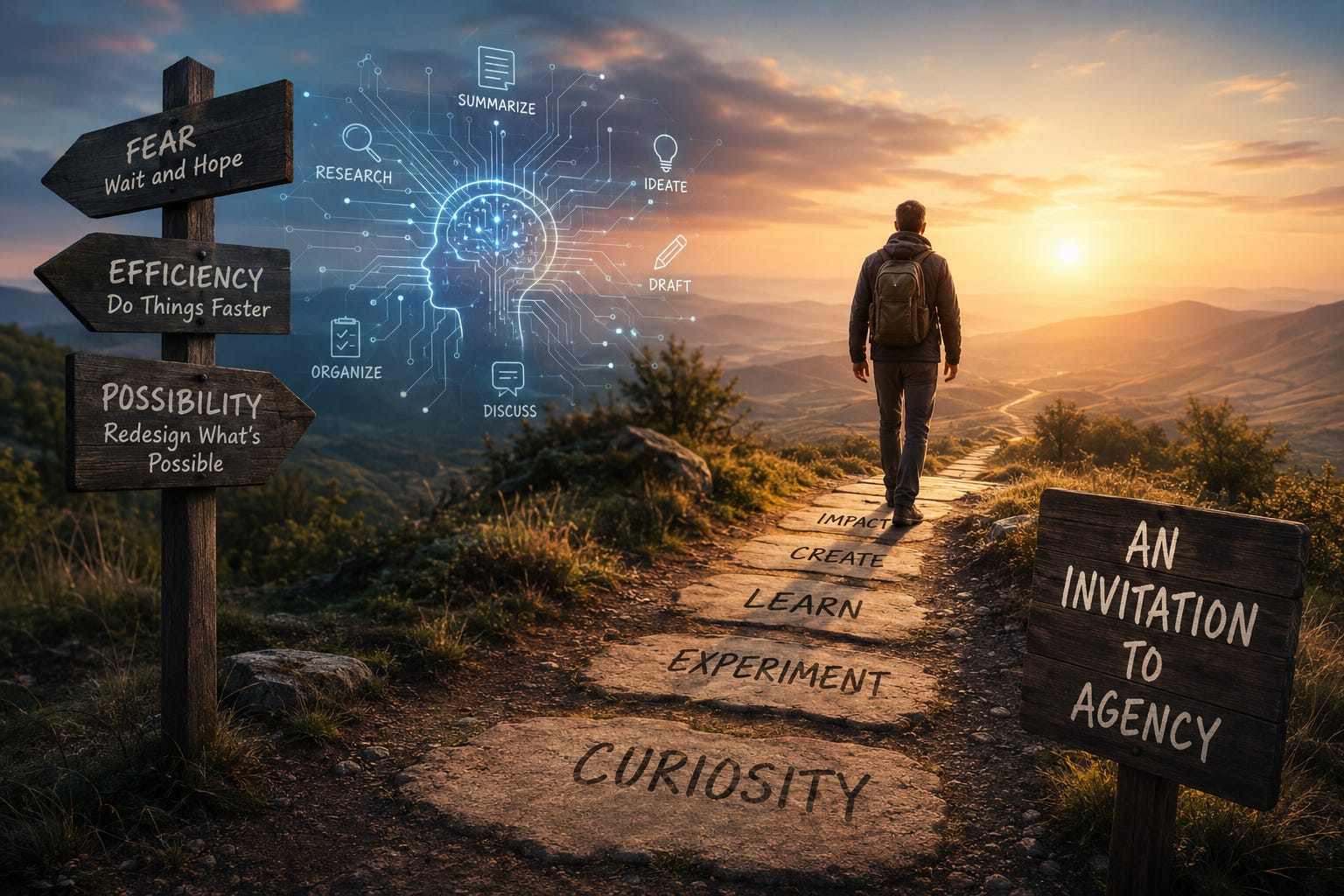
Looking back, I realize that artificial intelligence was never the most interesting part of the story.
The most interesting part was what happened when curiosity met opportunity.
That’s why I often think there are three common responses to major technological change.
Some people ignore it.
They hope it is overhyped. They assume it will eventually fade away. They wait for the dust to settle.
Others use it.
They summarize documents. Draft emails. Generate meeting notes. Create first drafts. They become more productive.
These are valuable outcomes.
But there is a third group that approaches change differently.
They redesign how they work.
Instead of asking, “How can this help me do my existing tasks faster?” they ask, “What becomes possible now that this capability exists?”
That question changes everything.
Historically, the people who benefit most from technological shifts are not always the most technical. They are often the people willing to experiment while everyone else is still debating. They learn before they feel ready. They build before they feel qualified. They remain curious longer than most.
When people tell me they are worried about AI replacing them, I often ask a simple question:
What part of your job would you gladly never do again?
The answers come quickly.
Formatting slides.
Searching through documents.
Creating status reports.
Organizing notes.
Writing routine communications.
Building first drafts.
Most people can immediately identify tasks that consume time without creating much fulfillment.
Then I ask a second question.
If those tasks required half the time, what would you do with the hours you got back?
The answers become much more interesting.
People talk about mentoring.
Building relationships.
Thinking strategically.
Solving problems.
Developing new skills.
Helping customers.
Supporting colleagues.
The activities they describe are often the parts of work they find most meaningful.
That doesn’t mean AI automatically creates a better future. Organizations will make choices. Leaders will make choices. Markets will make choices. No one can honestly predict exactly how it all unfolds.
What I do know is that focusing exclusively on what might be lost can prevent us from exploring what might be gained.
And that brings me back to agency.
The most powerful idea I’ve encountered through my exploration of AI isn’t a technical concept. It isn’t prompt engineering. It isn’t machine learning. It isn’t model architecture.
It’s agency.
The belief that we still have choices.
The belief that we can participate in shaping our future rather than simply waiting for the future to happen to us.
When people feel powerless, they withdraw. They wait for certainty before taking action.
When people feel agency, they experiment. They learn. They adapt. They create.
That’s the mindset I hope to encourage whenever I teach about AI.
Not blind optimism.
Not blind skepticism.
Agency.
Because none of us know exactly what work will look like ten years from now.
But we do get to decide how we respond to the uncertainty.
We can sit on the sidelines and hope things work out.
Or we can spend time understanding these tools, testing ideas, developing new skills, and expanding our understanding of what is possible.
When people ask me how to prepare for an AI-enabled future, they are often looking for a shortcut. A framework. A prompt. A list of tools.
Those things have their place.
But my answer is usually much simpler.
Get curious. Spend a few hours each week exploring. Build something small. Pay attention to what works and what doesn’t.
Most importantly, remember that this isn’t ultimately a story about artificial intelligence.
It’s a story about human capability.
The people who thrive in the years ahead may not be the technical experts. They may simply be the people who learn how to combine their experience, judgment, creativity, and curiosity with these new tools.
That is the opportunity in front of us.
Not certainty.
Not guarantees.
Not predictions.
An invitation to agency.
And in a time when so many people feel like the future is happening to them, that invitation may be one of the most valuable gifts we can offer ourselves and each other.