

“I’ll never forget those words: Give up that idea; that job doesn’t make enough money.”
I was fifteen years old and wanted to become a firefighter like my grandfather. I don’t even remember who said those words to me, but I remember exactly how they felt. In one moment, something that once felt exciting and possible suddenly felt unrealistic. Maybe it was practical advice. Maybe it was well-intentioned. Either way, it hit hard.
What followed were years of searching for direction. I bounced between colleges, universities, and trade schools trying to figure out who I was supposed to become. I spent an enormous amount of time inside my own head, replaying conversations, second-guessing decisions, analyzing every emotional reaction, searching for the magical insight that would suddenly make everything clear. At the time, I thought I was becoming self-aware. Looking back now, I can see that I was mostly stuck in rumination.
That distinction matters more than people realize.
And it turns out I wasn’t unique. What I was doing — mistaking constant thinking for actual awareness — is closer to the default mode most people operate in.
Today, self-awareness has become one of the most overused ideas in leadership, coaching, and personal development. Everyone talks about it. Organizations build programs around it. Leaders claim to value it. Most people believe they already have it.
Research from Dr. Tasha Eurich challenged that assumption years ago when she found that while the vast majority of people believe they are self-aware, only a small percentage actually are. More than a decade later, I think that gap may have grown even wider.
We live in a culture that encourages constant self-expression but not necessarily honest self-examination. People are more comfortable talking about themselves than truly confronting themselves. We carefully curate identities online, talk openly about growth and healing, and learn the language of emotional intelligence. But knowing the vocabulary of self-awareness is not the same thing as practicing it.
That was one of the biggest lessons I had to learn personally.
For years, I assumed that endlessly thinking about my life meant I was making progress. What I eventually realized is that introspection can become a trap when it lacks direction. Reflection helps when it creates clarity, accountability, and behavioral change. Rumination simply keeps you spinning in circles.
The turning point came when I leaned into something my parents instilled in me early in life: never stop growing. Stay curious. Embrace change. Explore what’s possible. I developed a restless spirit that pushed me toward learning, adapting, and challenging myself. Somewhere inside that process, I stopped obsessing over who I thought I should become and started paying closer attention to who I actually was.
That shift changed everything.
Instead of constantly asking, “Why am I like this?” I started asking different questions. What patterns keep repeating in my life? What situations consistently trigger frustration or insecurity? What feedback do I instinctively resist? What impact do I have on the people around me?
Those questions moved me toward awareness instead of analysis.
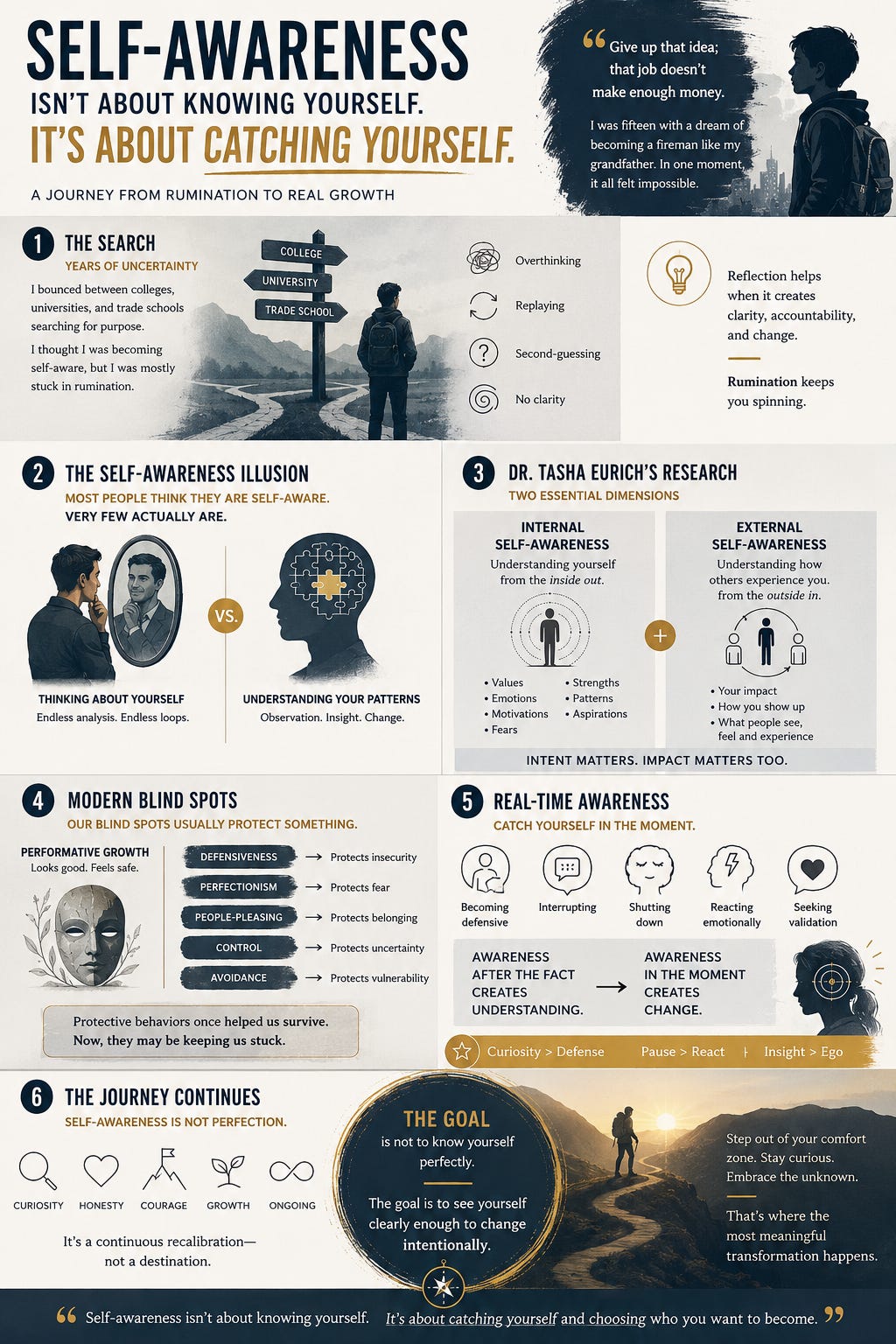
One of the reasons Tasha Eurich’s work resonates with me so deeply is because it gave structure to something many people experience but struggle to define. Her research identified two types of self-awareness: internal self-awareness and external self-awareness.
Internal self-awareness is understanding yourself from the inside out. It involves recognizing your values, fears, emotional patterns, motivations, strengths, weaknesses, and aspirations. It’s your ability to honestly assess what drives you and what holds you back.
External self-awareness is something entirely different. It’s understanding how other people experience you.
Not how you intend to come across.
Not the story you tell yourself about who you are.
The actual impact you have on the people around you.
That distinction can be uncomfortable because intent and impact are often very different things. You may think you’re being direct while others experience you as dismissive. You may think you’re calm under pressure while your team experiences emotional distance. You may believe you’re collaborative while the people around you feel controlled or unheard.
None of that makes someone a bad person. It makes them human.
We all have blind spots. The challenge is that most blind spots protect something deeper. Defensiveness often protects insecurity. Perfectionism can protect fear of failure. People-pleasing may protect belonging. Control often protects uncertainty. Many of the behaviors we struggle with today started as adaptations that once helped us survive, succeed, or feel accepted.
Over time, those protective behaviors quietly become identity. Once that happens, feedback starts feeling personal.
I think that’s one reason self-awareness feels threatening for so many people. Growth sounds exciting until it requires you to question the version of yourself you’ve spent years protecting. Most people say they want honest feedback right up until they receive it.
The people I’ve met who demonstrate genuine self-awareness tend to share one common trait: curiosity. They stay curious longer than most people. Instead of immediately defending themselves, they pause long enough to ask, “Is there something here I need to see?” That doesn’t mean every criticism is accurate. Some feedback is unfair. Some is projection. But self-aware people resist the urge to automatically reject discomfort simply because it feels uncomfortable.
That mindset became increasingly important to me early in my career. Over time, I discovered that my greatest passion was not simply professional success. It was helping people grow.
Tasha Eurich has a name for people with high external but low internal self-awareness. She calls them Pleasers: people who prioritize others’ opinions, expectations, and approval over their own instincts and needs.
My wife used to live in that category.
She was in a job she genuinely loved when her manager moved into another role. An opportunity opened up, and she considered applying, but deep down she wasn’t convinced it was the right fit for her. Instead of trusting her instincts, she leaned heavily on the opinions of others and gave their perspectives more weight than her own inner voice.
She applied for the role, got the job, and quickly realized she hated it. Within a year, she went from thriving in work she loved to leaving the company entirely.
As difficult as that season was, it became a turning point. She began paying closer attention to her internal signals instead of outsourcing her decisions to everyone around her. She clarified her values, practiced setting boundaries, and slowly started building self-worth and self-compassion. That experience taught her something powerful: self-awareness is not just understanding how others see you. It’s learning to trust yourself enough to listen to your own voice too.
What became obvious to me over the years is that self-awareness is deeply personal, but the process underneath it is surprisingly consistent. The patterns differ from person to person, but growth often begins the same way: you start noticing yourself in real time.
You notice the defensiveness. The shutdown. The need for approval. The controlling behavior. The avoidance.
And once you can catch the pattern while it’s happening, you can finally interrupt it.
That’s why I’ve started thinking about self-awareness differently over the last few years. I no longer think it’s primarily about understanding yourself during quiet moments of reflection. I think the real work happens in live moments, while life is unfolding in real time.
Can you catch yourself becoming defensive during a difficult conversation? Can you notice when your ego takes over? Can you recognize when fear is shaping your reaction before you say something you regret? Can you see your patterns while they are happening instead of only after the damage is done?
Awareness after the fact creates understanding.
Awareness in the moment creates change.

I learned that the hard way.
As a seasoned manager, I believed I was good at assessing talent. I had a team member who desperately wanted to move into leadership, but in my eyes he was too raw. His communication style could be abrupt, he lacked polish, and while confidence was never his issue, I questioned whether he had the interpersonal skills to effectively lead people.
I sat down with him to discuss his future, but looking back, I did far more talking than listening. At one point I even cut him off mid-sentence and gave him what I thought was the unvarnished truth: he did not have what it took to be a manager.
And then I heard myself.
Years earlier, someone had crushed my dream with what they probably believed was practical advice. Now I was doing the same thing to someone else. I had become the dream killer.
After the conversation, I paused and reflected on what had really happened. Was I accurately assessing his potential, or was I defining him by who he was in that moment instead of who he could become with guidance, coaching, and experience?
That moment changed me as a leader.
Instead of closing the door, I reopened the conversation. We worked on it together for years — the communication, the presence, the self-awareness he hadn’t yet developed and I had almost denied him the chance to build. It wasn’t always easy. He was far from perfect.
But over time, he grew into one of my most trusted managers.
He’s still leading people today.
What that experience taught me wasn’t about management. It was about self-awareness. Sometimes the most important moments in growth happen when you catch yourself in the middle of a pattern you didn’t know you were repeating.
I’m still a work in progress, and honestly, I hope I always am. Some of the most meaningful growth in my life has happened outside my comfort zone, in moments where certainty disappeared and curiosity took its place. That’s where self-awareness deepens. That’s where transformation begins.
Not through perfection.
Not through endless analysis.
Through the catch. In the moment. While it still matters.